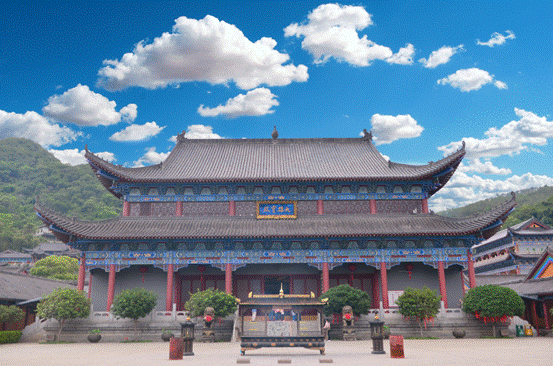
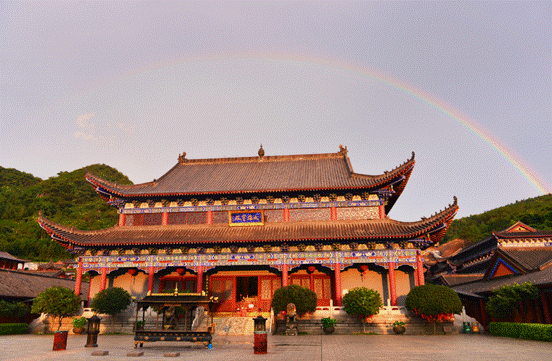
Among the magnificent buildings of Donghua Zen Temple, the Main Buddha Hall radiates reverent solemnity. More than the temple’s architectural core, it is a sacred space where monks gather daily for meditation, rituals, and prayers to dispel misfortune. Today, join us in exploring the Main Buddha Hall and lift the veil on its story.
Passing through the majestic Triple Gate Hall, we stand before the Main Buddha Hall. This grand structure exudes solemn dignity with its flying eaves, bracket systems, and intricately carved beams and pillars—all radiating ancient elegance. Inside the Great Buddha Hall are three colossal Buddha statues: Sakyamuni Buddha at the center, Amitabha Buddha to the left, and Medicine Buddha to the right. At 16 meters tall, they are the tallest Buddha statues in any Guangdong temple hall, inspiring profound reverence.
Observing closely, you might wonder why these three Buddhas share similar features. In essence, attaining Buddhahood means achieving perfect virtue and a perfected form, and thus their appearances naturally align. All Buddhas embody the equal and majestic form. To distinguish them, focus on their hand gestures: The Medicine Buddha’s downward-pressed palm forms the Gesture of Quenching, symbolizing the end of war, plague, and greed, anger, and ignorance; the Amitabha Buddha’s upturned hand shows the Gesture of Welcome, guiding all beings; the Sakyamuni Buddha’s Diamond Seal, also known as Subduing Evil Seal, Cosmic Balance Seal and Meditation Stabilization Seal, symbolizes the harmony of balance between yin and yang and the universe. Beside Shakyamuni Buddha are an elder and a younger figure, representing the Venerable Mahakasyapa and the Venerable Ananda, respectively. This signifies that practicing Buddhism is not dependent on age or seniority, everyone can attain enlightenment and become a Buddha through spiritual cultivation.
The statues appear bronze-toned but are actually gilded. Originally, budget constraints led to using 66% gold leaf instead of 99% pure gold—unexpectedly achieving a remarkable aged bronze appearance that became an artistic breakthrough, inspiring many temples to follow suit.
The Buddha statue’s eyes are particularly unique. Whether viewed from the front or the sides, one feels that the Buddha’s eyes are gazing directly at them. This is achieved through a masterful technique of opening the eyes, symbolizing the Buddha’s impartiality and compassion for all beings. The pearl gold used for the pupils is extracted from shells, combining breathable durability with preciousness for lasting quality. The halo behind the Buddha statue is circular, symbolizing perfection, distinct from flame-shaped halos of guardian deities. The Buddha’s halo is the sacred white light, shining as brilliantly as Mount Sumeru.
Flanking the Main Buddha Hall stand scripture pillars shaped like treasure vases, uniquely displaying the Platform Sutra of the Sixth Patriarch. Donghua Zen Temple is China’s only monastery presenting this seminal text through such an artistic form. These treasure vases embody “possessing meditative stability and being free from outflows” symbolizing perfect wisdom and fortune, peace and prosperity. They are believed to fulfill all vows of sentient beings, endure through generations, and bless all with auspiciousness. According to the theory of quantum mechanics, placing personal genetic tokens within the vases is regarded as equivalent to attending sutra ceremonies in the hall. Through daily morning and evening rituals, monks chant sutras to channel blessings to devotees, generating profound merit.
The Main Buddha Hall holds profound Buddhist culture and cherished prayers, awaiting more people to come and explore.(translator: Jiang Renfeng)